|
The older we get the more we may realize that not much in life matters if we don't have love. Love of family and friends. Love of work and creative expression. Love of the Earth and her bounty. Love of growth and the opportunity to be all that we can be. But in order to receive this love, we must have an open heart. We must be able to fully give love, too.
Today let us re-dedicate ourselves to living with wide-open hearts as best we can; to not shut down or close off to others; to not judge or discriminate or neglect. Let us extend ourselves to others as best we can. Let us live with unconditional friendliness toward all beings, both animal and human. Let us we be kind. This is a life worth living, one rooted in love. ©2023, Janice L. Lundy How can you be with yourself in a more kindly way?
Would it be to quiet yourself and rest? To let go of a pressing deadline? To re-engage a spiritual practice you've been too busy to enjoy? Choose one. Do one. Do a good deed today by being good to you. These days, this is very much where I find myself:
The older we get the more we may realize that not much in life matters if we don't have love. Love of family and friends. Love of work and creative expression. Love of the Earth and her bounty. Love of growth and the opportunity to be all that we can be. But in order to receive this love, we must have an open heart. We must be able to fully give love, too. Today let us re-dedicate ourselves to living with wide-open hearts as best we can; to not shut down or close off to others; to not judge or discriminate or neglect. Let us extend ourselves to others as best we can. Let us live with unconditional friendliness toward all beings, both animal and human. Let us we be kind. This is a life worth living, one rooted in love. Let us be kind when it comes to how we speak. We can learn to speak directly, to make our thoughts and needs known, yet do so with grace and dignity.
Gentle speech is sourced in confidence and self-knowledge. We can express ourselves clearly, aware that each word we speak has the power to help or heal the situation. We choose wisely for we wish to be known—but to cause no harm. ©2023, Janice L. Lundy  Many years ago I did a kind thing for myself. I stopped trying to create balance in my life. Instead I made a kinder choice: create inner harmony.
Balance, by its very nature, is impossible to achieve. Nothing is ever balanced (I'm thinking of the see-saw [teeter-totter) of my childhood here ...). It's either up or down. Too much or too little. Trying to achieve balance for me was a self-defeating choice because no one can ever get anything "just right." I experienced trying to get my life in balance as pressure, resulting in failure (of course!)—a misguided attempt at perfection. But harmony, oh, that had a lovely, gentle ring to it. It reminded me of musical notes coming together in a pleasing way. More like rhythm. A delightful blending of elements that just flowed. Now this I could get behind. I decided to pitch balance and opt for harmony instead. Instead of striving for and struggling with balance, how can we shift our efforts to focus instead on creating inner harmony? Here's an idea, a simple starting point. You can begin to create greater harmony in your life by paying close attention to what your body is trying to tell you in any given situation, honoring that revelation, then making choices that foster your well-being. You can do this by literally listening to your body through the vehicle of your senses. Pay mindful attention to what you are seeing and hearing. Note your body's response. Ask yourself, 'Is this experience creating feelings of peace and well-being in me, or is it causing me stress, worry, pressure or fear?' When we listen mindfully, we can make healthy, new choices for ourselves—choices rooted in loving-kindness. And new choices are easy to make and implement when they are sourced in self-kindness. ©2024, Janice L. Lundy His Holiness the Dalai Lama has said: "As long as we live in this world we are bound to encounter problems. If, at such times, we lose hope and become discouraged, we diminish our ability to face difficulties."
In keeping with this line of thinking, an act of self-compassion would be one of self-support when something in your life feels difficult. There are many things you can do to drop into a self-compassionate stance when you are struggling. You can speak tenderly to yourself. You can stop pressuring yourself to "fix” the feeling, vowing instead to remain calm and wait for clarity to come. You can offer phrases of Metta (loving-kindness) to yourself. You can go outside and lift your face to the sky. Instead of fighting with life as it arises, let us drop into life and flow with its rhythms by being kindly compassionate toward ourselves. ©2023, Janice L. Lundy Are you kind to your mind? We often think about being kind to our body. We give it rest, nurturing, and what it needs to be well. What would it mean if you were kind to your mind in the same way? Consider developing an attitude of loving-kindness toward it, just as you would toward a little child, thinking of your mind as tender and dear.
It's a fair guess to say that very few of us have done this. If anything, we may be self-critical of what goes on in our mind— judgmental, harsh, or impatient—because we are frustrated by its many thoughts. We may feel inadequate because we not proficient at keeping a calm mind or meditating. Our thoughts being of a certain nature, may feel that we are not “spiritual enough.” Instead of fault-finding, take a gentler approach toward your mind. Offer blessings of loving-kindness to your mind, such as these: May I relax and rest in pure awareness today. May I be at peace with everything that arises. May my mind be at ease, my heart at rest. May all be well. ©2023, Janice L. Lundy All Rights Reserved Befriending, becoming a loving, understanding, and compassionate friend to yourself, is a powerful spiritual practice.
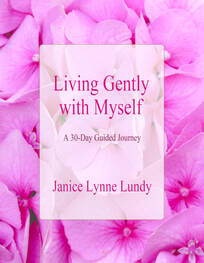
Befriending begins with holding an intention to live more kindly and gently with yourself. Are you able to do that? Though intention and an attitude of loving-kindness towards yourself may not be enough. Befriending must be personified by acts of loving-kindness, tangible choices made on a moment-to-moment basis to do the kindest thing for you. Doing so is not a selfish act as some would say, but a self-aware one. Learning to befriend myself has been a lifelong journey. It is the subject of my book, Living Gently with Myself, which you can learn more about here. Within each of us are the answers to our deepest questions. We have been conditioned to believe that the answers to life's dilemmas are "out there somewhere" and we must search to find them. Nothing could be further from the truth.
The deepest wisdom lies within you and silence is the only way to access the answers you desire. By sinking into silence, you will uncover more insights than you ever dreamed possible. Silence is your soul's companion. ©2023, Jan Lundy All Rights Reserved.  Love naturally resides within you. It is ever present. You do not have to actively search for it, combing the world for the perfect partner to have it. It may sound trite but it takes diving into your own depths to pull up the love that is there to get the love that you’ve always wanted.
Begin by showering it upon yourself; accepting yourself in all your pain and glory as a sacred being having a very human (and sometimes painful) experience of life. Then, as you begin to fill your own well with love, more love will bubble up, like water from a natural spring. From there, it will organically flow out from you and into the world for others to feel. They will want to be close to it, desire to drink of it themselves. The cycle of love flows most sincerely from self to others and back to self again. ©2023, Janice L. Lundy |
Gentle and timely reminders for the spiritual journey, because sometimes we forget or need a kind nudge back to Center.
Archives
July 2024
Categories
All
|
 RSS Feed